
German Goulash
Inside: Step-by-step directions for how to make a German goulash using a Dutch oven, Crock Pot (or another slow cooker), or Instant Pot. Plus, what to serve with this classic recipe.
German goulash (Rindergulasch) is a thick beef stew made with almost as many onions as beef, cooked down slowly with paprika, caraway, marjoram, red wine and a spoonful of tomato paste until the sauce turns dark and glossy. It’s thicker and richer than Hungarian goulash, which is closer to a soup, and it has nothing in common with the macaroni-and-ground-beef goulash a lot of us grew up on. Serve it over spaetzle, buttered egg noodles or potatoes. You’ll spend about 30 minutes of hands-on time, then the oven (or a slow cooker or Instant Pot) does the rest.

One-pot stews are the dinners my family and friends ask for most, including my Dutch Oven Beef Stew with Red Wine, this Beef Carbonnade and, at the top of the list, this German Goulash.
The difference between Hungarian and German goulash is that the Hungarian version includes potatoes and carrots while German goulash is heavy on onions and enriched with red wine, without the root vegetables.
Why you’ll love this recipe:
- Nearly a 1:1 ratio of onions to beef, the hallmark of a real German goulash. The onions melt into the gravy.
- It’s a one-pot meal that feeds the whole family.
- It can be prepped in about 30 minutes, and most of the cooking is hands-off.
- German goulash is naturally gluten-free; the stew thickens as it reduces and simmers.
- It can be made ahead.
- This German goulash recipe freezes and reheats well.
Ingredients for German goulash
- Onions—This recipe uses 1½ pounds of onions. That might seem like a lot but the onions cook down until they’re soft and sweet. They add depth without the sting to this German stew.
- Olive Oil – for sweating the vegetables and searing the beef.
- Beef Chuck Roast – Chuck roast is good for long simmers as it gets fork-tender while braising.
- Green Pepper—Green peppers have a stronger vegetal quality than sweet peppers. I include them for more aromatics and flavor, but it’s optional.
- Garlic – while this allium is sharp when raw, the sting will mellow as you braise the German goulash.
- Tomato – during the cooking process, the tomato will melt into the stew.
- Salt – you can use regular iodized salt or kosher salt.
- Pepper – freshly ground will have the most potent flavor.
- Paprika – to add color and flavor to the German goulash stew.
- Marjoram – is a woody, floral citrusy spice with a milder flavor than oregano.
- Tomato Paste is concentrated and gives the German goulash gravy flavor and color.
- Caraway Seed is the characteristic ingredient of this German stew. It has a distinct flavor, like anise, and a bitterness that ameliorates the licorice notes.
- Beef Broth—Look for low-sodium beef broth because the stew needs a long simmer, which will concentrate the stock. A full-sodium broth will make the goulash taste saltier.
- Red Wine–doesn’t have to be expensive, just something you would like to drink.
Using a package of stew meat:
- If you don’t have a whole chuck roast, a package of beef for stew works fine. Note, it’s usually a mixture of beef cuts, some may require more braising time. Ultimately, use what you have.
About paprika:
There are several paprika types; this recipe uses Hungarian paprika.
- Hungarian paprika–Hungarian paprika comes in several grades, from sweet to hot. I use sweet Hungarian paprika here, but hot is fine if you like heat, or use a blend of half each.
- Sweet paprika–is made from sweet dried peppers and adds color but little heat to finished dishes. This is the type of paprika you want to add a hint of color without changing the flavor profile of a dish.
- Smoked paprika–a.k.a. pimentón or Spanish paprika, is made from peppers smoked over wood fires. They add a definitive, rich smokiness to many dishes. True pimentón is made according to stringent, regulated standards.
I prefer to make the beef goulash in the Dutch oven, starting on the stove and finishing in the oven–it fills the house with the most wonderful aromas. However, I’ve also included methods for making it on the stove, in a Crock Pot or in an Instant Pot. (See the recipe card below.)
Step-by-step instructions:

- In a large heavy pot or Dutch oven, cook the onions in olive oil over medium heat for 15 minutes, stirring occasionally until they’re very soft and sweet.

2. Add the bell peppers, tomato and garlic and cook for 5 minutes until the vegetables are soft and fragrant. Transfer the onion mixture to a bowl.

3. Cut the beef chuck roast into cubes. Add the beef to the Dutch oven and cook for 5-10 minutes until it’s browned outside.

4. Transfer the onion mixture back to the beef along with salt, pepper, paprika, marjoram, tomato paste, caraway seed, beef broth and red wine.

5. Stir to combine and heat the goulash to boiling. Place the lid on the pot so it’s slightly askew and steam can escape and transfer to the oven—Braise for 1½ to 2 hours.

6. Remove the pot from the oven and stir the mixture well to recombine. You can serve traditional German Goulash on its own, in a bowl or with some starch, typically German spaetzle or boiled potatoes.
Pro Tips:
- Check the dates on your spices. Ground spices’ flavor diminishes over time. Most will be good for six months to a year, and whole spices can last up to 2 years. Ensure that yours are flavorful by using your NOSE. Smell the spices. If the aroma is muted, they’re probably old, and you’ll want to replenish your stock before making this German goulash.
- Don’t crowd the beef when browning. If the pot is too full, the meat will steam and boil, not sear.
- Use a good quality beef stock. I use my homemade beef stock (made from beef neck bones), but you can also use a good low-sodium store-bought brand. As it cooks, some liquids evaporate, and if you use a regular sodium stock, it can over-salt the dish.
- Though many Omas make their own spaetzle to serve with goulash, you can find these thick, chewy noodles sold dried in many supermarkets. I bought mine at The Fresh Market.

Variations:
- Add ½ cup of sour cream or crème fraiche to make the sauce creamier.
- To add a bit more acidity, stir in 1-2 teaspoons of red wine vinegar before braising the goulash.
- Swap the wine for dark beer, the Bavarian approach.
- Pork goulash: use pork shoulder, same method, check tenderness at about 1¼ hrs.

FAQs
Beef chuck, nearly as many onions by weight, paprika, caraway, marjoram, tomato paste, beef broth and red wine.
The onion-heavy ratio, caraway and marjoram, wine, and a thick, gravy-like sauce. No potatoes or carrots in the pot.
It started in Hungary. German cooks adopted it and made it into a thicker, wine-enriched stew.
Close cousins. Bavarian versions often use dark beer instead of wine.
Yes. This recipe adapts well to both, though the methods change slightly. Cooking times in the Slow Cooker on low 6–8 hrs; on high 3–4. For the Instant Pot 35 min high pressure plus natural release. See the recipe card for full details.
Simmer uncovered, use a cornstarch slurry, and stir in sour cream at the end.
Make Ahead:
- You can make this recipe several days before (I think the flavors deepen overnight). Let the goulash cool to room temperature and refrigerate it in a sealed container for 3-4 days.
Storage:
- Store the German goulash in an airtight container in the refrigerator for up to 3-4 days.
Reheating:
- To reheat, transfer to a heavy-bottomed saucepan over medium heat with the lid on, stirring occasionally until it’s warmed through.
Freezing:
- Freeze the German beef stew in freezer-safe storage containers for up to 3 months. Defrost entirely before reheating.

What to serve with German goulash
- Buttered Egg Noodles
- Spaetzle
- Browned Butter Sea Salt Mashed Potatoes
- Buttered Parsley Potatoes
- Potato Dumplings
- Braised Red Cabbage and Apples
What readers are saying:
This homemade German goulash is very popular with my followers, here’s what a few of them had to say:
Eiko says: “Best German Goulash recipe ever! Followed the recipe exactly. Great Flavor! Will be making this over and over!”
From Lynda: “Great goulash recipe good flavour.”
Kim says: “Family enjoyed this dish!! Easy to make. Tastes better when making a day ahead of time.”
From Schwan: “I made this tonight per the recipe. It was excellent! Something different that I will definitely make again. Thanks!”

Other stews and braises:
- Veal Osso Buco
- Wine Braised Lamb Shanks
- Braised Pork Ragout
- Irish Stout Lamb Stew
- Chicken Stew with Fall Vegetables
- Green Chili Stew
- Coq Au Vin
More beef braises:
- Julia Child’s Beef Bourguignon Recipe
- Beef Carbonnade
- Dutch Oven Beef Stew with Red Wine
- Homestyle Pot Roast In A Dutch Oven
- Rich Beef Birria
More German dinners:
Made it? Leave a rating and comment!
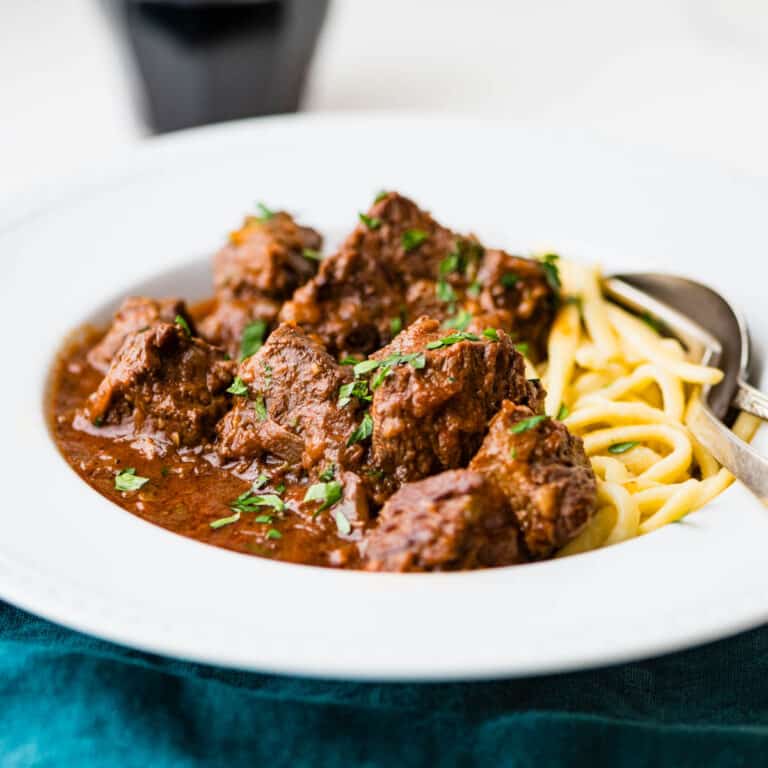
Classic German Goulash
SPECIAL EQUIPMENT:
- Dutch Oven
INGREDIENTS:
- 1½ pounds onions chopped
- 2 tablespoons olive oil
- 2 pounds beef chuck roast or stew beef cubed into 1 to 1 1/2" pieces
- ½ green pepper chopped
- 3 cloves garlic minced
- ½ tomato seeded and diced, (about 1/3 cup)
- 1 teaspoon kosher salt divided
- ½ teaspoon black pepper
- 2 tablespoons sweet Hungarian paprika
- 2 teaspoons dried marjoram
- 1 teaspoon caraway seed
- 2 tablespoons tomato paste
- 2 cups beef broth or bouillion
- ½ cup dry red wine
- 1 bay leaf
- ¼ cup chopped fresh parsley
DIRECTIONS:
- Place the oven rack in the center of the oven and preheat to 325°.
- Add 2 tablespoons olive oil to a heavy pot or Dutch oven and heat over medium heat. Add 1½ pounds onions and ½ teaspoon of kosher salt. Cook for 15 minutes, stirring occasionally, until the onions are very tender and golden.
- Add ½ green pepper, ½ tomato, 3 cloves garlicand cook for 5 minutes, until the vegetables are softened and fragrant. Transfer to a bowl.
- Season 2 pounds beef chuck roast or stew beef with the remaining salt and ½ teaspoon black pepper and transfer to the Dutch Oven. Cook over medium-high heat for 5-10 minutes or until the beef has browned.
- Add the vegetables back to the beef and stir in 2 tablespoons sweet Hungarian paprika, 2 teaspoons dried marjoram, 1 teaspoon caraway seed, 2 tablespoons tomato paste, 2 cups beef broth, ½ cup dry red wine and 1 bay leaf to the pot. Heat to boiling.
- Place the lid on the pot, so that it's askew and steam can escape. Transfer the pot to the oven and cook for 1½ hours or until the beef is tender.
- Remove the pot from the oven and garnish with ¼ cup chopped fresh parsley and serve with spaetzle, buttered noodles or potatoes.
TO MAKE GERMAN GOULASH IN A SLOW COOKER OR CROCK POT:
- Follow the instructions to the point of browning the meat, then transfer the ingredients to the slow cooker. Cover with the lid and cook on low for 6-8 hours or on high for 3-4. If the stew isn't as thick as you'd like, let it simmer without the lid for 45 minutes to an hour towards the end of cooking to evaporate some of the liquid.
STOVETOP METHOD:
- After the goulash comes to a boil, reduce the heat to medium or medium-low and place the lid on the pot so it's slightly askew and steam can escape. Simmer for 1½ to 2 hours, stirring occasionally to prevent sticking and/or burning.
TO MAKE GERMAN GOULASH IN THE INSTANT POT:
- Follow the instructions to combine the browned meat with the other ingredients, then bring the pot to high pressure and cook for 35 minutes. Let the pressure release naturally. To thicken, simmer the goulash using the sauté function, occasionally stirring (so the bottom of the pot doesn't scorch). As the liquid evaporates, the stew will thicken in about 10-15 minutes.
RECIPE VIDEO:
NOTES:
- For an even thicker sauce, combine 1½ teaspoons of cornstarch with two teaspoons of cold water to make a slurry. Add it to the beef stew mixture and heat to a boil. Cook and stir until it thickens.
- If you’re adding sour cream, add it at the end.
- If using a packaged beef broth, I recommend a low-sodium variety. Simmering the German goulash will naturally evaporate some of the liquid, thus concentrating the sauce, which can easily become too salty as a result.
- Ensure your spices are still flavorful by checking the expiration dates. Spices that are pre-ground lose their potency after 6-12 months.
NUTRITION:
Nutritional Disclaimer
Nutritional information is an estimate only and is provided as a courtesy. Values are calculated automatically based on the ingredients and quantities in each recipe and may vary depending on specific brands, exact measurements, and substitutions made. For precise nutritional guidance, especially if you have a medical condition or dietary restriction, please consult a registered dietitian or run the ingredients through your own nutrition calculator.History of Goulash
The term “goulash” has evolved over time to mean a “soup or stew,” but its origins date back to the Hungarian cattle herders (gulyás) who drove herds across the plains.
Traditionally, Goulash soup was made with weaker cattle that couldn’t survive the arduous trip. Every part of the animal was used, and shepherds relied on it during those long treks to market their steers.
Onions and caraway, prolific on the plains of Hungary, were natural mainstays to season the goulash. (Paprika wasn’t introduced until centuries later.)
As the gulyás traveled between towns and cities, selling cattle and sharing their goulash, it became a popular dish in each region they visited. Variations to the traditional goulash recipe sprang up from the different locales, each putting their twist on classic Hungarian goulash.
What’s the difference between German and Hungarian goulash?
Goulash recipe variations abound, depending on who’s making it. Here’s a small, but not exhaustive, list.
- Hungarian Goulash is traditionally served as a soup. Sometimes, potatoes are added to add starch and thicken the hearty soup.
- German Goulash is enriched with red wine but no potatoes. It is more of a stew than a soup.
- Czech Goulash – Can be made with pork or beef and is served with bread dumplings, fresh onion and beer.
- Croatia – Replaces beef with venison or wild boar and often adds porcini mushrooms and bacon (that sounds good).
- Italy: In addition to beef and red wine, it’s seasoned with paprika, rosemary, marjoram and lemon zest and often served with soft polenta.
- Poland – Eaten all over the country, Goulash is usually served with mashed potatoes or over noodles.
- Serbian Goulash is typically made with beef, veal, or pork, but sometimes wild game. It’s served with noodles or mashed potatoes.
- Slovenian Goulash is usually made with at least two types of meat and is commonly served with mashed potatoes.
- U.S. and Canada-their versions don’t qualify as goulash, in my opinion. A typical American goulash is made with ground beef instead of chunks of meat, lots of tomatoes (where tomatoes and tomato paste are sparingly used in more traditional recipes ), and the elbow macaroni is cooked in the same pot as the meat. I’d categorize it as an easy one-pot or skillet dinner (it’s good, but it is not goulash).
Pin it for later!

Wasn’t a huge fan of goulash until I had this recipe. We used a Guinness Stout instead of wine and loved it! Definitely recommend trying this recipe!
Wow!!! You had me at 1 1/2 lbs of onions! Can’t wait to give this a try!
So you didnt add the chopped garlic to the onion to fry it a little? Just added it raw to th pot mixture?
Correct. Though you could. Honestly, it braises long enough that there isn’t any raw garlic flavor.
So super easy and absolutely delish! Can’t wait to make again.
I saw this recipe and thought the image of the goulash looked really yummy I made it for my husband and I with chuck beef cubes from the butcher. This dish is so delicious and warming with just enough heat. I would definitely recommend this recipe
This was very good. Delicious!
Absolutely Delicious! We all Loved it and will be making it again and again!! Thank you so much for sharing!! *5-Stars*****
Amazing! This was so incredibly good. My kids have asked me to make it again next week.
What a great recipe. I served it over mashed potatoes and there were no leftovers.
Amazing! My family loved it.
I made this for dinner tonight. I don’t have a Dutch oven, so I started the dish in a pot on the stove top. Then I finished it on high for about 3 1/2 hours in a crock pot. I thickened the gravy with corn starch and then added the sour cream. I served it with mashed potatoes. It was delicious!
I’ve made this twice and it’s delicious! Love how fast it is in the instant pot
Flavor was excellent. I did not use the wine (added a little balsamic vinegar instead) or caraway seeds, and used Herbs d Provence instead of marjoram, because that’s what I had. Next time I would take lid off for the last half hour to thicken up sauce.